
Rendering & Solid Plastering in Adelaide
Render gives a house a clean, solid finish and protects the walls underneath it. We render and solid plaster new builds, renovations and extensions across Adelaide, inside and out, on brick, blueboard, foam cladding and Hebel.
Because we are builders as well as renderers, we look at why a wall needs rendering before we cover it. Render over a wall that is still moving will crack again, so we find the cause first.
At a glance
- Cement, acrylic and textured finishes, matched to the wall and the look you want
- Brick, blueboard, foam cladding and Hebel, on new builds, renovations and re-renders
- Existing textures matched on repairs and extensions, so new work does not stand out
- Internal solid plastering, including bathrooms prepared for waterproofing and tiling
- Finished ready for paint, with painting available from the same team
Some of the finishes we can provide are:
- Acrylic Texture Coat
- Bagged Finish
- Float & Set
- Pebble Dash
- Sponge Finish
- Steel Trowel Finish
- Stucco
- Texture Coat
- Tyrolean
- White Set

Why render a house?
Most people render for one of three reasons.
- To change how the house looks. Render covers tired, patchy or mismatched brickwork and gives the whole house one clean finish.
- To tie old and new together. On an extension or a big renovation, rendering the old and new walls in one finish makes them read as one building. It is often the last step in our home renovations and the work of our extension builders.
- To finish a new build or cladding system. Blueboard, foam cladding and Hebel are designed to be rendered, and the render system is part of how the wall performs. We render them on new homes as well as on additions.
A sound render system also sheds weather off the wall, and painted with a suitable system it is a low-maintenance finish for South Australian conditions.
Cement render or acrylic render: which suits your wall?
Both are used on Adelaide homes, and the right one depends on the wall underneath and the finish you want.
| Cement render | Acrylic render and texture coats | |
|---|---|---|
| What it is made of | Sand, cement and water | An acrylic polymer binder |
| How it handles movement | Rigid once cured, so movement in the wall can show as cracks | More flexible, so better at handling minor movement |
| Typical finishes | Bagged, float and set, sponge, steel trowel, white set | Textured and coloured finishes, often over a base coat |
| How it is finished | Painted once fully cured | Coloured, or coated with a paint system made for render |
On lightweight cladding like foam, Hebel and blueboard, the render system is set by the cladding manufacturer, and we follow it. On brick, the choice is usually about the finish you want and how much the wall is likely to move.
Why does render crack?
Render cracks for two main reasons.
Shrinkage. Render shrinks slightly as it dries, and fine surface cracking is a known issue with rendered walls. Good preparation, the right mix and proper curing keep it to a minimum.
Movement. When the wall moves, the render moves with it, and rigid render is where that shows. In Adelaide, the ground is often the cause. A September 2026 Adelaide University field study on an Adelaide site recorded soil shrinkage cracks 5 to 40 millimetres wide and up to a metre deep, deepest in the dry months of March and April.
That is why we do not just patch a crack and walk away. A hairline crack in an otherwise sound wall is a straightforward repair. A crack that keeps coming back, or one that steps through the brickwork, has a cause behind it, and that needs sorting before the wall is re-rendered. We will tell you honestly which one you have, including when it needs an engineer’s eye rather than another coat of render.
What affects the cost of rendering?
Every render job is priced on the walls in front of us. These are the things that move the price most:
- Wall area and height. More square metres cost more, and a second storey usually means scaffolding.
- The condition of the wall. New blueboard is quicker to render than old brick that needs cleaning, repairs, or loose and hollow render taken off first.
- The finish. A single texture coat is a different job to a multi-coat smooth finish like float and set or steel trowel.
- Matching an existing finish. Blending new render into an old texture on an extension or repair takes extra care.
- Access. Tight side passages, steep blocks and established gardens all slow the job down.
- Painting. Whether the quote includes painting or sealing the render once it has cured.
Your free quote sets out the preparation, the render and any painting as separate items, so you can see where the money goes.
How we render a wall
1. Inspect
We look at the wall, the substrate and any existing cracks, and agree the finish with you, including matching an existing texture if needed.
2. Prepare
We clean the wall, repair damage, remove loose or hollow render, set corners and joints, and protect your windows, paths and garden.
3. Base coat
The base coat goes on to build the wall out flat and true, ready for the finish.
4. Finish coat
The finish coat or texture is applied to give the look you chose.
5. Cure and paint
New render is left to cure fully before painting, for as long as the manufacturer’s data sheet specifies. Our painting team can then finish it, so you deal with one crew from bare wall to final coat.
What is solid plastering?
Solid plastering is plaster or render applied wet, by hand, directly onto masonry, usually inside the house.
Many older Adelaide homes have solid plastered walls, and repairing or matching them properly needs a solid plasterer rather than a sheet of plasterboard. We also solid plaster wet areas so they are ready for waterproofing and tiling, which is part of how we run bathroom renovations in Adelaide.
Newer homes mostly use plasterboard, which our team installs and finishes as gyprock fixing and flushing. For a seamless polished mineral finish on walls, benchtops or showers, there is Venetian plastering.
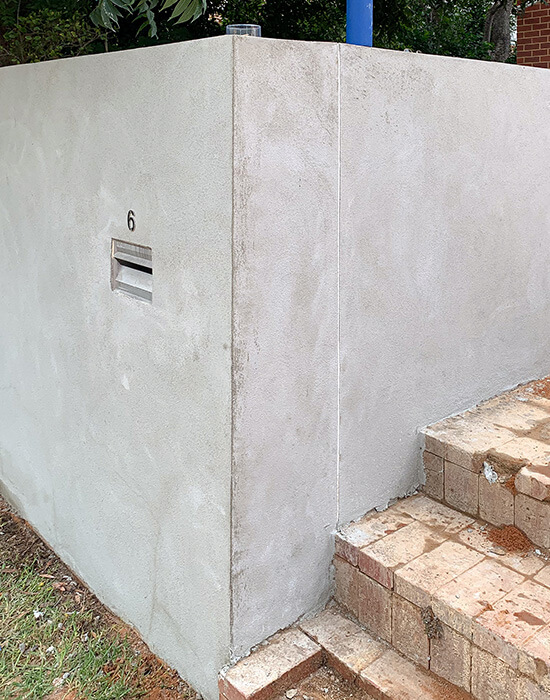
Rendering as part of the whole job
On our Beaumont project we delivered the full set of external finishes: exterior cladding, fascias, rendering and texturing, exterior paintwork and a stone feature wall to the front elevation. Because one team handled every finish, the textures and colours were planned together rather than left to chance.
Based on the mid coast, we render homes across all areas of metropolitan Adelaide and regional South Australia. If you are planning a render job, get a free quote and we will come and look at the walls.
Frequently Asked Questions
It depends on the wall area and height, the condition of the wall, the finish you choose, access, and whether painting is included. A second storey usually needs scaffolding, and old brick that needs cleaning, repairs or loose render removed takes longer to prepare than new blueboard. RAW Structures prices every render job after seeing the walls, and the free quote lists preparation, render and painting separately.
Cement render is made from sand, cement and water and is rigid once cured, so movement in the wall can show as cracks. Acrylic render and texture coats use an acrylic polymer binder, which makes them more flexible and better at handling minor movement. RAW Structures recommends one or the other based on the wall underneath and the finish you want, and on lightweight cladding we use the system the cladding manufacturer specifies.
Yes. Face brick can be rendered once it is clean, sound and properly prepared, and painted brick needs extra preparation so the render can bond to it. Any cracked or moving brickwork has to be dealt with first, or the crack will come back through the new render. RAW Structures checks the wall when we quote and tells you exactly what preparation it needs.
Most render cracks come from shrinkage as the render dries, or from movement in the wall or the ground beneath it. In Adelaide, reactive clay soils that shrink and swell with the seasons are a common cause of movement. A hairline crack in a sound wall is a simple repair, but a crack that keeps coming back has a cause that needs fixing first. RAW Structures will tell you which one you have, including when it needs an engineer to look at it.
Only once it has fully cured. Curing time depends on the product, the thickness and the weather, so we follow the manufacturer’s data sheet rather than a rule of thumb. RAW Structures can paint the render as well, so the timing is managed by one team.
Yes. RAW Structures renders Hebel, foam cladding and blueboard on new builds, extensions and renovations. Each of these is designed to be rendered with the system its manufacturer specifies, and we follow that system so the wall performs the way it is meant to.
Solid plastering is plaster or render applied wet, by hand, directly onto masonry, usually inside the house. Many older Adelaide homes have solid plastered walls, and repairing or matching them needs a solid plasterer rather than plasterboard. RAW Structures does solid plastering for repairs, renovations and wet areas being prepared for waterproofing and tiling.
Yes. RAW Structures matches existing textures on repairs and extensions, so the new work does not stand out from the old. A close match is easiest when the existing finish is in good condition, and on a whole elevation it can be better to re-coat the full wall so the colour and texture are even. We will talk you through the options when we look at the job.